
Westminster Wood Flooring handles hardwood floor installation in Westminster, CA, serving surrounding cities including Midway City, Garden Grove, Stanton, Fountain Valley and Huntington Beach. With 20+ years of installing solid and engineered hardwood, we treat the first day of the job as the one that decides how the floor looks in ten years: the subfloor is checked, the moisture is measured and the layout is planned before any board goes down.
The choices that matter most are made before installation: species and grade, solid or engineered, board width, prefinished or site-finished, and nail-down, glue-down or floating. We walk you through each one against the subfloor you actually have, and every choice goes on a written, itemized estimate so the price of each option is plain.
Choosing Species, Grade and Board Width
Oak, Hickory, Maple and Walnut
White oak and red oak remain the most common installed species because they take stain predictably and wear well. White oak has a cooler, grayer tone and tighter grain; red oak is warmer, with a pinkish cast and more open grain. Hickory is harder and shows dramatic color variation from board to board.
Maple is hard and smooth but blotches under dark stain. Walnut is softer and prized for its deep brown color, best suited to rooms with lighter traffic.
Hardness and the Janka Rating
The Janka hardness rating measures the force needed to press a steel ball halfway into a sample of wood, and it is a useful guide for comparing species. It is not the only factor in how a floor wears: the finish takes most of the daily abrasion, and a lighter color or matte sheen hides scratches that would stand out on a dark, glossy floor. We weigh hardness, color and finish together against how the room is used.
Grade and Plank Width
Grade describes appearance rather than strength: clear and select grades show few knots and little color variation, while character and rustic grades show more knots, mineral streaks and color change. Width changes the look as well. Narrow strip floors suit many older houses, while wide plank floors show more grain and fewer seams but move more with humidity, which is why wide boards are often engineered.
Solid Hardwood Over Wood Subfloors
Nail-Down Installation
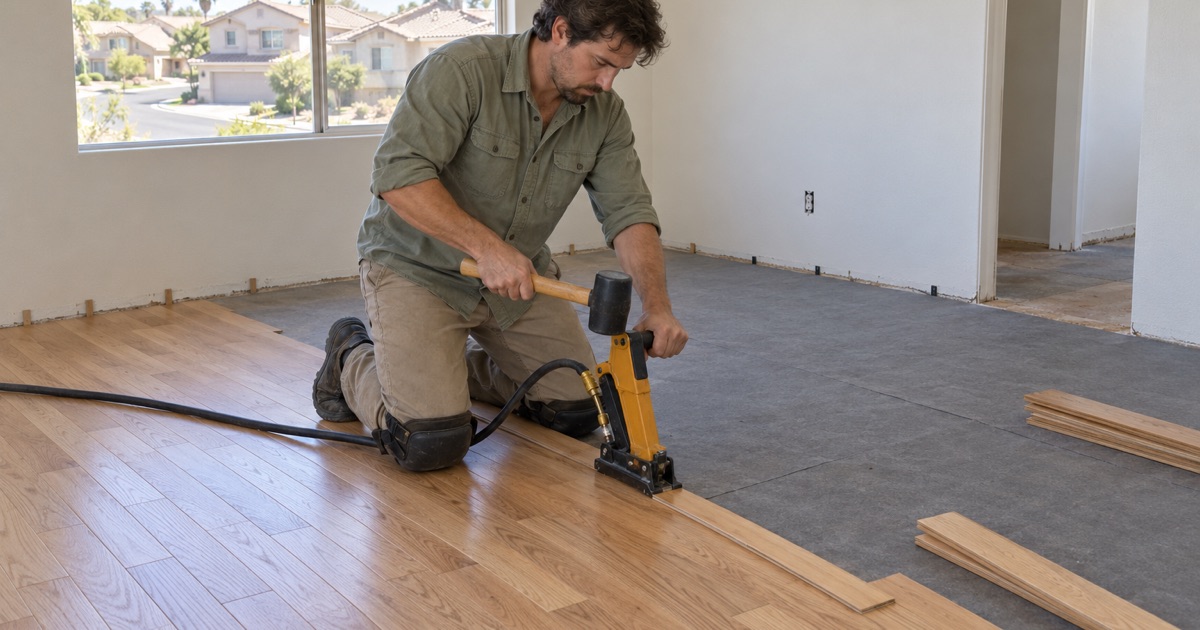
Solid hardwood is usually nailed or stapled to a plywood subfloor with cleat nails or flooring staples driven through the tongue at an angle, following NWFA installation guidelines for fastener type and spacing. Boards run perpendicular to the floor joists where possible, which spreads the load and reduces movement. A layer of underlayment paper between the subfloor and the flooring helps with minor friction noise and moisture.
Acclimation and Moisture Content
Wood that is installed wetter or drier than the house will be once it is lived in will shrink or swell after installation, leaving gaps or cupping. We measure the moisture content of the flooring and the subfloor with a wood moisture meter and compare them against the manufacturer’s requirement. Installation starts when the readings are within range, and the numbers are written down on the job record.
Expansion Gap, Layout and Trim
Every wood floor needs room to move at the walls, so we leave the expansion gap the manufacturer calls for around the perimeter and at fixed objects such as cabinets and columns. Baseboards or shoe molding cover it. Layout lines are set before the first row so the floor runs square to the main walls, and boards are blended from several boxes to spread color and grain evenly across the room.
Hardwood on Concrete Slabs
Testing the Slab First
A concrete slab can give off moisture that will cup or debond a new wood floor, even when the surface feels dry. We test with the ASTM F2170 in-situ relative humidity method or a calcium chloride test and compare the result with the flooring manufacturer’s limit before anything is ordered. A high reading changes the plan to include a vapor retarder, a moisture-control adhesive or a different product.
Engineered, Glue-Down and Floating Options
On concrete, engineered hardwood is usually the right product, either glued directly to the slab or floated over an underlayment. Solid hardwood can go over concrete only with a plywood subfloor installed on top of the slab, which raises the floor height and affects doors and transitions. We price both where they make sense, so the choice is made with the real costs in view.
Clearing Old Flooring Off the Slab
A slab that once carried glued-down wood, vinyl, carpet or tile keeps the adhesive, tack strip nails and patch lines left behind. New flooring will not bond reliably to old adhesive, and ridges in the concrete telegraph through the boards. We remove the old layers, grind the slab back to clean concrete, fill low spots and retest the moisture once the surface is open. Old 9x9 tile and black mastic are tested for asbestos before grinding or scraping, so a hidden hazard is handled properly rather than spread through the house as dust.
Transitions, Stairs and Finishing
Prefinished Against Site-Finished Floors
Prefinished boards carry a factory-cured finish that is harder than most site-applied coatings, and the room is ready as soon as installation is complete. Site-finished floors are sanded flat and coated in place, giving a smooth surface without beveled edges and any stain color you choose. Site-applied finishes follow SCAQMD Rule 1113, which limits wood coatings in this basin to 275 grams per liter of VOC.
Transitions and Stairs
Where the new floor meets tile, carpet or a different height, we fit a reducer strip, T-molding or threshold so the change is smooth underfoot. Where the floor reaches a staircase, stair treads, risers and nosings are planned as part of the same job and priced per tread and riser, so the stairs and the floor above them match in species, color and finish.
- 20+ Years of Floor Work
- Written, Itemized Estimates
- Moisture Readings Recorded