
Westminster Wood Flooring builds and refinishes hardwood stairs in Westminster, CA, serving surrounding cities including Midway City, Garden Grove, Stanton, Fountain Valley and Huntington Beach. Stairs are usually the last part of a house to lose its carpet and the first thing people notice once it is gone. With 20+ years of wood flooring work behind us, we treat each flight as its own piece of joinery rather than an afterthought to the floor.
That is also how we price it. Every stair job is estimated per tread and riser, with nosings, landings, skirt boards and railings listed separately, so the cost of the staircase is visible on the written, itemized estimate instead of folded into a square-foot number for the floor above.
Converting Carpeted Stairs to Hardwood
What Is Under Stair Carpet
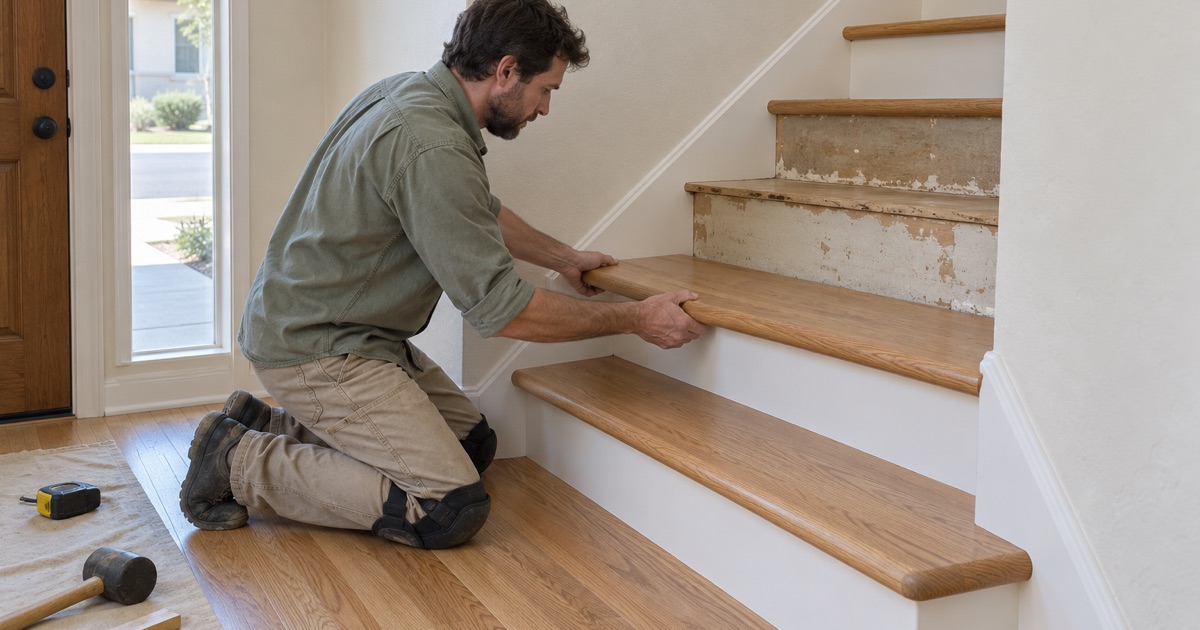
Carpeted stairs are usually built with rough treads and risers made from construction lumber or plywood, never meant to be seen. The carpet, pad and tack strip come off first, followed by every staple and nail. We then measure each step, because older stairs are rarely perfectly uniform, and a new tread cut to one template can leave gaps at the walls or a rocking step.
Capping or Replacing the Old Treads
There are two common routes. Capping fits a new hardwood tread over the existing one after the old nosing is cut back flush, which avoids disturbing the stair structure. Full replacement removes the old treads and installs solid hardwood treads in their place. We recommend the method that keeps each step’s finished height consistent with the steps around it and with the floors at the top and bottom.
Risers, Skirt Boards and Landings
Risers can be finished in wood to match the treads, or painted for contrast, which is a popular look and keeps scuffs from showing. Skirt boards along the walls are trimmed or replaced so the new treads meet them cleanly. Landings are treated as a small floor, installed and finished with the same species and color as the treads, so the whole run reads as one project.
Treads, Nosings and Wear
Choosing a Species for Stairs
The front edge of each tread takes most of the traffic in a house, so stairs benefit from harder species. Red oak and white oak are the most common stair woods and take stain evenly, while hickory and maple rate higher on the Janka hardness scale. Most homeowners match the stairs to the floor they connect to, so we source treads in the same species and grade.
Stair Nosing Profiles
The stair nosing is the rounded front edge of each tread, and on the top step it becomes a separate nosing piece where the stairs meet the upper floor. A good nosing is solid, flush and continuous with the floor, not a thin molding tacked on. Worn or rounded nosings on existing stairs are rebuilt or replaced, since a soft front edge is both a looks problem and a place where feet slip.
Traction and Finish Sheen
Smooth hardwood feels slicker than carpet underfoot, especially in socks. A satin or matte finish gives noticeably more grip than gloss, and some finishes can take an anti-slip additive. A runner down the center of the stairs is another option, protecting the wood where traffic is heaviest while leaving the edges exposed.
Refinishing Existing Wood Stairs
Hand Sanding Step by Step
A staircase cannot be sanded with a drum sander, so each tread, riser and nosing is sanded with small power sanders, scrapers and hand work. It takes more time per square foot than a floor, which is another reason stairs are priced per step. Corners where the tread meets the riser and the skirt board get the most attention, since that is where old finish and dirt build up.
Stain and Finish Matching the Floor
When stairs are refinished along with the floor, they are stained and coated in the same sequence so the color and sheen match. We use finishes within the South Coast basin’s 275 g/L limit for wood coatings. Because stairs are often the only route between floors, we plan the coats so one side or alternate steps can be used while the rest dries.
Replacing Cracked or Damaged Treads
A cracked tread, a tread that flexes or a nosing split along its length is replaced rather than filled. The new tread is cut to the exact width and depth of the step, fastened and glued to the structure below and stained to match. Loose treads that squeak are refastened and glued to stop the movement at its source.
Stairs as Part of a Bigger Floor Job
Planning Stairs With New Hardwood
When new hardwood goes in upstairs or downstairs, the stairs should be planned at the same time. The finished floor height decides how the top nosing and bottom step meet the floor, and a stair left carpeted between two new wood floors often looks unfinished. We schedule the stair work so the floor and the flight share the same wood, stain and finish.
Stairs in Condos and Townhomes
In townhomes and two-story condos, an association may have rules on flooring changes, work hours and noise, and stairs that share a wall with a neighbor carry sound. We read the association’s rules before starting and plan the work within the permitted hours. Where noise is a concern, a runner on the new stairs reduces footstep sound.
Painted Risers in Pre-1978 Houses
Stairs in older houses often have painted risers, skirt boards and balusters, and in a home built before 1978 that paint may contain lead. Sanding or cutting through it without controls spreads lead dust through the stairwell and the rooms around it. We follow EPA Renovation, Repair and Painting rule work practices on those surfaces, with containment and cleanup that keep the dust out of the living space, before any new tread or finish goes on.
- 20+ Years of Floor Work
- Written, Itemized Estimates
- Moisture Readings Recorded